Rameswaram
|
Rameswaram is a small island in the Gulf of Mannar, is a major pilgrim centre. It is connected to the mainland by road and railway bridges. Rameswaram is a holy place because Sri Rama, on his return from Sri Lanka, offered his thanks to Lord Shiva and performed pooja to wash away his sin in killing the Demon King, Ravana. Rameswaram is known for its 22 theerthas or wells in and around the main temple.
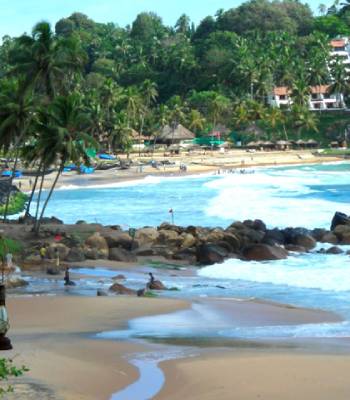
This place is equally sacred to both Vaishnavites and Shaivites. According to Hindu Mythology, if one visits Rameswaram and prays to Lord Shiva one will be relieved of one's sins. It is 197 metres long.The Ramanathaswamy temple is renowned for its magnificent corridors and massive sculptured pillars. The third corridor of Ramanathaswamy temple is the longest one in the world.Besides pilgrimage, Rameswaram Island has several places, which are ideal picnic spots. There are beautiful beaches at Olaikuda, Dhanushkodi and Pamban. The Olaikuda beach is 1 km from the main temple and s engulfed by coral reefs, which makes bathing in the sea safe and enjoyable. With diving glasses and respiration tubes, scuba diving is safe and possible. Flamingos, sea gulls and a variety of birds migrate to the Rameswaram Island during winter.
Rameswaram is a main fishing centre of Tamil Nadu. Variety of fishes including export quality fish like prawns, sea cucumber, and lobster are available here. Rameswaram is also famous for its dry fish.
The famous Ramanathaswamy Temple is regarded as one of the most sacred shrines of Hindus in India. It is an honoured pilgrimage destination, which represents the southernmost of the 12 Jyotirlingams of India. It is considered as holy as Banaras. This famous Hindu temple situated on the Rameshwaram island is located off the Sethu coast of Tamil Nadu. The temple is noted for its close association with Ramayana and the legendary victory of Rama over the demon king Ravana.
This temple is a pious temple, keeping in mind its association with Lord Rama, a great Hindu legend and its grand structure. This huge temple on the island of Rameswaram can be reached via the Pamban bridge across the sea, it is famous for its long ornate corridors, towers and remarkable 36 Theerthams.
¤ Legend Related To The Temple
According to a legend, Rama worshiped Shiva in the form of a Shiva Lingam, while returning to Ayodhya. This lingam was made of earth by Rama's consort, Sita. It is also said that Hanuman was sent to bring an image of Viswanathar from Banares. Rama thought that Hanuman will be late in returning. Therefore, Rama is said to have offered worship at a pre-chosen auspicious moment to the Shivalingam. This lingam is referred to as Ramalingam.
The other Shivlingam brought here by Hanuman from Banaras is known as Viswanathar . This Shivalingam is also called Kasilingam and Hanumalingam. The Viswanathar Shivalingam is worshiped before offering prayers to Ramanathaswamy. It is also believed that Rama worshiped Tilakeswarar at Devipatnam on the route to Sri Lanka.
¤ The History of The Temple
It is said that the ancient shrine was placed in a thatched hut until the 12th century. Parakrama Bahu of Sri Lanka built the first ever masonry structure here. The Setupathy rulers of Ramanathapuram completed the rest of the temple. Some of the temple vimaanams are similar to the Vimaanams of the Pallava period. Much more was added to the temple between the 12th and the 16th centuries. The long corridor (3rd prakaram) dates back only to the 18th century. The Gandhamadhana Parvatam (hill) offers a panoramic view of the temple. Travancore, Ramanathapuram, Mysore and Pudukkottai kingdoms provided royal patronage to this famous Hindu temple.
¤ The Temple Architecture
The temple is sprawled over an area of 15 acres. It has huge gopurams, monolithic walls and a stupendous Nandi. There is a 4000 feet long pillar corridor with over 4000 pillars, considered the longest in the world. A unique feature about this corridor is that the rock used here is not found on the native island, it was brought in from elsewhere in Tamilnadu across the sea. The eastern Rajagopuram has a height of 126 feet and has nine levels whereas the western Rajagopuram is not as tall as the eastern one. The huge image of Nandi is about 18 feet tall and 22 feet in length.
¤ The Gandamadana Parvatham
This hill on the Rameshwaram island, has a small shrine, consisting of imprints of Lord Rama's feet, which is worshiped here. A worth visiting site.
¤ Theertham(Water Springs)
There almost 36 Theerthams here out of which 22 are in the temple. The water of these Theerthams are said to be therapeutic. A bath in these is regarded significant. The Agni Theertham refers to the ocean while the Koti theertham is located within the temple itself.
Ex-president of India, Dr. Abdul Kalam, hails from a fishing hamlet called Dhanushkodi situated on the island.
|
Guruvayoor is one of the most sacred and important pilgrim centres of Kerala. Its main attraction is the Sree Krishna temple. The temple is described as 'Bhooloka Vaikuntam' and 'Dwaraka of the south'. It is a heaven on earth for many. The temple opens to the melody of 'Nadaswaram' at 3 am every day for the 'Nirmalya Darshan'. Devotees make many offerings to propitiate the deity for health, wealth and prosperity.
This historic temple is shrouded in mystery. According to belief, the temple is the creation of Guru, the preceptor of the Gods, and Vayu, the God of winds. The eastern nada is the main entrance to the shrine. In the Chuttambalam (outer enclosure) is the tall 33.5 m high gold plated Dwajathambam (flag post). There is also a 7 m high Dipastambham (pillar of lamps), whose thirteen circular receptacles provide a truly gorgeous spectacle when lit. The square Sreekovil is the sacred sanctum sanctorum of the temple, housing the main deity. Within the temple there are also the images of Ganapathy, Lord Ayyappa and Edathedattu Kavil BhagaVathy. Only Hindus are allowed inside the temple. Budget and luxury hotels are available near to the temple.
You have options to visit 'Punnathur Kotta', where the 51 odd elephants of Guruvayoor temple are housed. This is the largest tamed elephant parl in the world.
Madurai is Known as Athens of the East, Madurai is a place of great historical and cultural importance. It is the oldest city in Tamil Nadu and Madurai lies on the banks of the River Vaigai. Madurai is one of the liveliest cities in South India it was originally known as Kadambavanam or the "forest of Kadamba" or the Nauclea kadamba .
Legend says that Lord Shiva appeared in the dream on the king, Kulasekhara Pandya. The king was amazed to see drops of nectar or madhu falling down of earth from Lord Shiva's matted hair. The "madhu" was so sweet that the place where it fell came to be known as Madhurapuri, which in course of time became "Madurai."
Tamil and Greek documents record its existence from the 4th century B.C. Being in the heart of Tamil Nadu, Madurai has fostered an essentially Dravidian and Tamil culture. Famous for its cultural and scholarly pursuits, the city had an academy consisting of critics, poets and savants highly esteemed both by kings and commoners. It was in Madurai that three successful conferences of Tamil scholars called sangams flourished under benevolent royal support.
Madurai is famous for housing one of the five traditional dance halls where Lord Siva, in his form as the Silver Hall or the Velli Ambalam. It is situated within the Meenakshi Temple.
Madurai was the capital of the dynasty. The Meenakshi-Sundareswarar Shrine is its central glory. The Muslims invaded Madurai in the 14th Century. Later it came under the rule of the Nayaks, and the rule of Thirumalai Nayak, who is remembered as the maker of modern Madurai, was an eventful one.
Madurai was known to be the center of learning and pilgrimage for centuries. Today, Madurai is a modern commercial and industrial city, with a vast University campus and is renowned for its weaving mills and dyeing industry. The chungadi cotton sarees are the speciality of this city with its colourful tie and dye motifs. Handicrafts, brassware, bronze items and the famous wooden toys of Madurai are some of the notable artifacts. Madurai is 450 kms from Chennai.
Meenakshi Temple
No text can do justice to the Meenakshi temple. The gigantic temple complex, the statues exploring the entire range of human emotions, everything here is larger than life. The Meenakshi temple complex is a city temple - one of the largest and certainly one of the most ancient. According to legend Madurai is the actual site where the wedding between Shiva and Meenakshi took place. The soaring and exquisitely carved towers enclose the temple dedicated to Meenakashi. The south gateway contains the twin temples of Shiva and Meenakshi and is about nine storeys high.
The Origin Of The Meenakshi Temple
The Sri Meenakshi Sundareswara temple and Madurai city originated together. According to tradition, Indra once committed sin when he killed a demon, who was then performing penance. He could find no relief from remorse in his own kingdom. He came down to earth. While passing through a forest of Kadamba trees in Pandya land, he felt relieved of his burden. His servitors told him that there was a Shivalinga under a Kadamba tree and beside a lake. Certain that it was the Linga that had helped him; he worshipped it and built a small temple around it. It is believed that it is this Linga, which is till under worship in the Madurai temple. The shrine is called the "Indra Vimana".
Once Dhananjaya, a merchant of Manavur, where the Pandyas had arrived after the second deluge in Kumari Kandam, having been overtaken by nightfall in Kadamba forest, spent the night in the Indra Vimana. When next morning he woke up, he was surprised to see signs of worship. Thinking that it must be the work of the Devas, he told the Pandya, Kulasekhara, in Manavur, of this. Meanwhile Lord Shiva had instructed Pandya in a dream to build a temple and a city at the spot Dhananjaya would indicate. Kulasekhara did so. Thus originated the temple and city.
Earliest References Of The Temple
Paranjothi Munivar wrote the Tiruviayadal Puranam in the sixteenth century. It is regarded as the temple's Sthalapurana. An earlier work adds a few celestial sports not included in the latter. These are, or rather were painted on the walls around the Golden Lily Tank. Some of the painted wooden panels are in the Temple Museum.
The earliest references available to any structure in this temple is a hymn of Sambhandar's, in the seventh century, which refers to the "Kapali Madil". The present inner walls of the Lords shrine bear this name today. In the early times the entire temple must have been confined to the area between these walls, and the structures must have been of brick and mortar.
In the 14th century an invasion by Malik Kafur damaged the temple. In the same century Madurai was under Muslim rule for nearly fifty years. The temple authorities closed the sanctum, covered up the Linga, and set up another in the Ardhamandapa. When the city was liberated, the sanctum was opened, and, tradition says the flower garlands and the sandalwood paste placed on the Linga were as fresh as on the first day, and two oil lamps were still burning.
- Ashta Sakthi Mandapa
It is a convention in this temple, different from that followed in others, that the devotee offers worship first to Goddess Meenakshi. Therefore, while there are four other entrances into the temple, under huge Gopuras in the four cardinal directions, it is customary to enter not through any of them but through a Mandapa, with no tower above it. This entrance leads directly to the shrine of the Goddess.
This Mandapa is an impressive structure, with a hemispherical ceiling. It is 14m long and 5.5m wide. There are bas-reliefs all over the place. Over the entrance one of them depicts the marriage of Goddess Meenakshi with Lord Somasundara. The Mandapa derives its name, the "Ashta Sakthi", from the fact it contains sculptures of the eight Sakthis (also spelt as Shakti). Those of the four principal Nyanmars were added during renovation of the temple in 1960-63.
- Samagam Meenakshi Naicker Mandapa
A smaller Mandapa connects the large one with another large one with another large hall, called the "Samagam Meenakshi Naicker Mandapa", after its builder, a minister of Vijayaranga Chokkanatha (1706-32), who erected in 1707. In former times the temple's elephants camels and bulls used to be stabled here. A brass "Tiruvatchi" holding a thousand and eight lamps stands here, 7.6m high. Marudu Pandya, one of the early opponents of the growing British power, installed it.
The Meenakshi Naicker Mandapa is a huge hall, 42.9m long and 33.5m wide. It contains 110 stone columns, each 6.7m high. There are yalis in the capital and delicate reliefs below. Some of the carvings are unfinished.
- Mudali Pillai Mandapa
The Mudali Pillai Mandapa follows the Chitra Gopura. Added in 1613, it is 183m long and 7.6m wide. On its wall are many puranic scenes. It used to be without any natural light, but windows were added in the last renovation.
- The Golden Lily Tank
The lovely and historic Golden Lily tank then comes into view. It is from its banks that most popular photographic views of the temple are taken, showing the gigantic south outer Gopura. The northern corridor leads directly to the shrine of the Goddess. On its pillars are the images of some of the Sangam poets, of Kulasekhara Pandya, the first builder of the temple, and of Dhananjaya, who figures in the traditional story of its origin. There is no fish in the tank.
The corridors around the tank are rightly called the "Chitra Mandapa", for the walls carry paintings of the divine sports of the Lord, as narrated in the "Tiruvilayadal Puranam". They have been renewed from time to time. A short while ago there were paintings on wooden panels affixed over an older series. They have since been removed to the Temple Museum in the thousand-pillared Mandapa, leaving some dilapidated murals to view. It is impossible to ascertain the date of these.
It was in the sixteenth century that the corridors and the steps leading down to the tank were constructed; the northern corridor and steps in 1562, those on the east in 1573, and those on the south five years later.
- The Unjal And Kilikatti Mandapas
Two Mandapas, the Unjal and the Kilikatti, stand on the farther way to the shrine of the Goddess. On their ceilings are more paintings. A celebrated mural, opposite to the entrance of the shrine, depicts the marriage of Goddess Meenakshi. The Kilikatti Mandapa derives its name from the fact that there are parrots in a cage here. On its walls are carvings of the divine sports. The most ornamental of the temple's Mandapas, it was built in 1623.
A Gopura of three tiers stands over the entrance from this Mandapa into the shrine of the Goddess. Built in 1227 by Vambathura Ananda Tandava Nambi, it is named the Vambuthurar Gopura after him. The shrine consists of a square sanctum, an Ardhamandapa and a Mukhamandapa. In the niches on the walls of the shrine are images of Iccasakthi in the south, Kriyasakthi in the west, and Jnanasakthi in the north. There are shrines of Vinayaka and Subramanya in the outer Prakara. They probably belong to the fifteenth century.
The Historic Shrines In The Prakaras
There are a number of historic shrines in the Prakaras. Opposite to an entrance into the first from the Mahamandapa there is one of Lord Sabhapathi. This is the famous Velliambalam where one of the Lord's divine sports took place when, at the request of the sages, Patanjali and Vyagrapadha, He danced as Lord Nataraja.
In the second Prakara a shrine, now called that of the Sangam poets, contains images of many of them. In the same Prakara there is a shrine apparently dedicated to Kariyamanikka Perumal, but now empty. Also in the same Prakara there is a row of fourteen small shrines, called the "isvarams". Many of them contain Lingas.
Kanyakumari. Where three seas mingle. The tip of Indian peninsula was known as 'Cape Comorin' and today rechristened Kanyakumari, after the temple of vergin Goddess that stands on the shore washed by the waters of Indian occean, Bay of Bengal and Arabian sea. You can also visit Suchindram temple and Padmanabhapuram palace on the way to Thiruvananthapuram.
Places to Visit: Vivekananda Rock Memorial ( Ferry service-8.00 am to 4.00 pm), Thiruvalluvar statue, Gandhi memorial, Government Museum, Suchindram Temple(13 Km), Padmanabhapuram palace (37 Km).
Click here for more detail.
|